+254-701-648-558 | support@eventscatering.co.ke
Conference / Seminar / Workshop / Training Event Catering
Two hundred delegates break for tea at 10:30, and by 10:42 the queue still hasn’t cleared. The facilitator is standing at the podium waiting. The session restart slips by fifteen minutes nobody budgeted for, and the agenda for the rest of the day quietly falls apart. That gap between a tea break running long and a lunch service outlasting its slot is the single most common complaint from anyone who has ever organised a training programme in Kenya.
Conference / Seminar / Workshop / Training Event Catering solves a very specific version of the catering problem: feeding large groups of delegates on a schedule built around a session timetable rather than a meal, without the food ever becoming the reason the day runs late. Hauchi Kay has built its conference and training catering operation around exactly that constraint.
In short, this style of catering is defined less by the food itself and more by how the food is timed and served against an agenda that isn’t going to move for anyone. It typically covers four service points across a training day: a light breakfast for early arrivals, a morning tea break of ten to twenty minutes, a working lunch, and an afternoon tea break, repeated across multiple days for longer programmes. What separates it from a wedding buffet or a staff party is the discipline behind the scenes: enough serving stations to clear a queue in the time allotted, food that keeps concentration levels up rather than triggering an afternoon slump, and a rotation plan so a five-day training doesn’t serve the same sandwich platter twice.
A few things decide whether this kind of catering succeeds. Delegate count and the number of service stations, since a single buffet line for 150 people never clears in fifteen minutes. Session structure, since a plenary-only day has very different timing pressure to one broken into four breakout syndicate rooms running on staggered schedules. And programme length, because a single afternoon seminar has completely different menu planning needs to a five-day residential training where the same fifty people eat every meal together.
Conference, Seminar, Workshop or Training
These four words get used almost interchangeably by people booking catering, and honestly, in day to day conversation they often are the same thing. But the catering brief underneath each one is not identical, and knowing the difference helps you brief a caterer properly and avoid paying for the wrong service style.
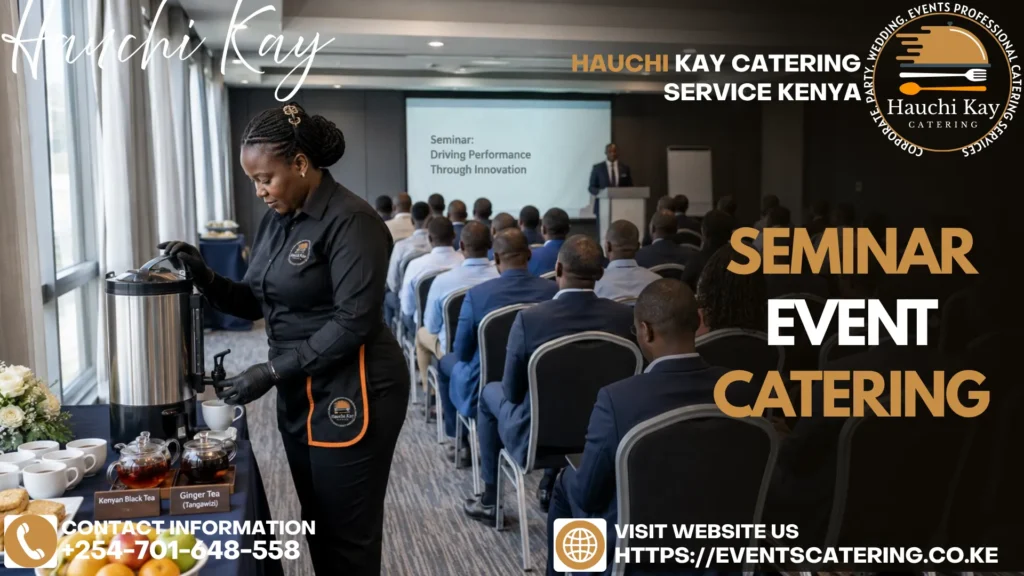
A conference usually means the largest headcount and the most rigid timetable, often a single day with a plenary hall, multiple speakers, and fixed breaks that cannot slip because a speaker’s flight or a sponsor slot depends on it. A seminar tends to run smaller, sometimes half a day, often centred on one topic with a single speaker or panel, which means the catering can afford to be a little more relaxed on timing but still needs to be quick and quiet since the room is usually seated theatre-style with minimal disruption tolerance.
A workshop is participatory rather than passive: delegates are working in groups, moving between stations or breakout rooms, and food often needs to be positioned so people can grab a plate without abandoning a group exercise mid-flow. A training programme is usually the longest format, spanning two to five days or more, and its catering challenge is less about any single break and more about sustaining variety and energy across the whole run without anyone getting tired of the menu by day three.
| Format | Typical Duration | Seating Style | Catering Pressure Point |
| Conference | Single day, sometimes two | Theatre or classroom, plenary hall | Tight, fixed breaks around multiple speaker slots |
| Seminar | Half day to full day | Theatre style, seated | Quiet, minimal disruption service |
| Workshop | Full day, sometimes multi-day | Round tables, breakout groups | Grab and go access without breaking group work |
| Training | Two to five days or more | Classroom or U-shape, residential possible | Menu rotation and sustained delegate energy |
Hauchi Kay briefs every one of these differently, because the pricing table on Hauchi Kay’s Corporate Catering in Kenya page gives an overview across all eleven corporate categories, but a training coordinator planning a five-day residential programme needs a different conversation to someone booking a single afternoon seminar.
Where the Time Actually Goes: Tea Breaks, Queues and the Twenty Minute Problem
Ask any training coordinator what worries them most about catering and it’s rarely the food quality. It’s the clock. A tea break scheduled for fifteen minutes that actually takes twenty five doesn’t just annoy delegates, it pushes the whole afternoon back, and by the third break of the day a programme can lose forty minutes it never gets back.
Queue Engineering, Not More Food
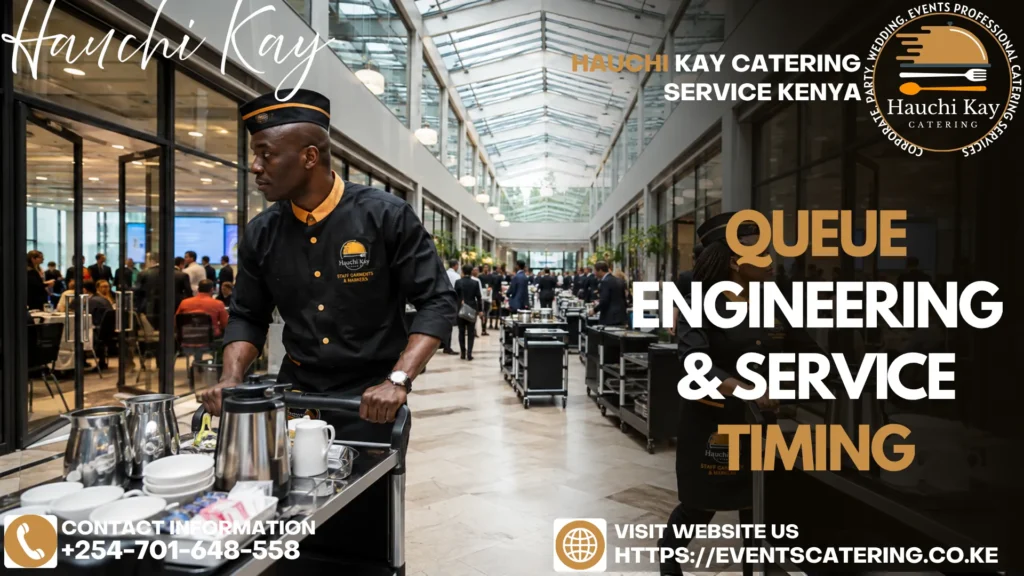
The fix isn’t more food, it’s better queue engineering. For any group over sixty delegates, a single serving table is the wrong call regardless of how much staff you throw at it, because physics limits how fast one line can move. Hauchi Kay works from a rough rule of one serving station per forty to fifty delegates for tea breaks, and one station per seventy to eighty for a buffet lunch where portions take longer to plate. Splitting urns and flasks across two ends of a room rather than one central table alone can cut a queue time in half. For very large conferences, pre-portioned grab-and-go stations, sealed cups of coffee, wrapped pastries, bottled juice, move faster than any self-serve line and work particularly well when a break is deliberately kept to ten minutes.
Staggering Service to the Room, Not the Building
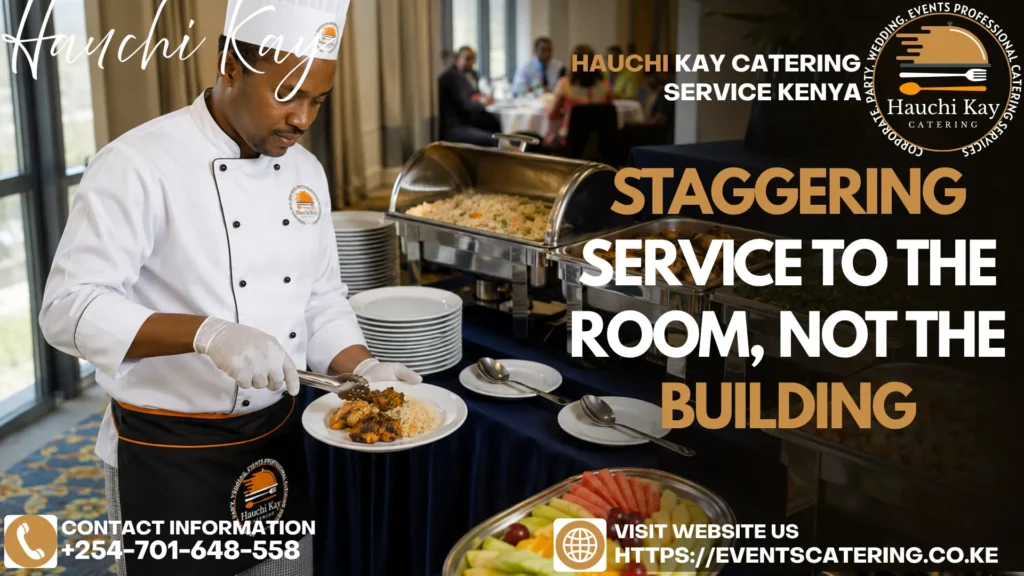
Staggering also matters more than most people expect. If a conference has four breakout rooms finishing at slightly different times, serving tea from the moment the first room breaks rather than waiting for all four to empty avoids a single crush fifteen minutes later. Hauchi Kay’s event coordinators usually ask for the session timetable in advance specifically so breaks can be staffed to the room, not just the building.
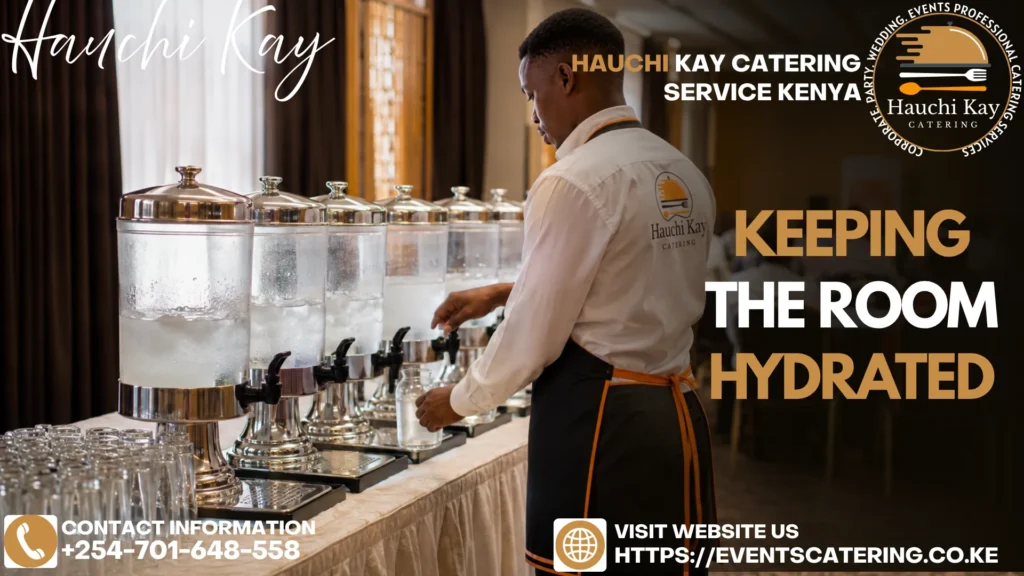
Keeping the Room Hydrated
Water matters more in Kenya’s training rooms than caterers often plan for, particularly during the warmer months or in venues with limited air conditioning. Chilled water dispensers positioned at the back of a hall, refreshed at each break rather than left to run low by midday, keep a room from getting restless in the final hour before lunch.
Multi-Day Training Without Menu Repetition
A one-off seminar lunch only has to be good once. A five-day training has to be good five times in a row without anyone at the table quietly dreading day four’s menu because they recognise it from day one. This is where a lot of catering plans fall apart, not because the food is bad, but because it repeats.
Building a Rotation That Doesn’t Repeat
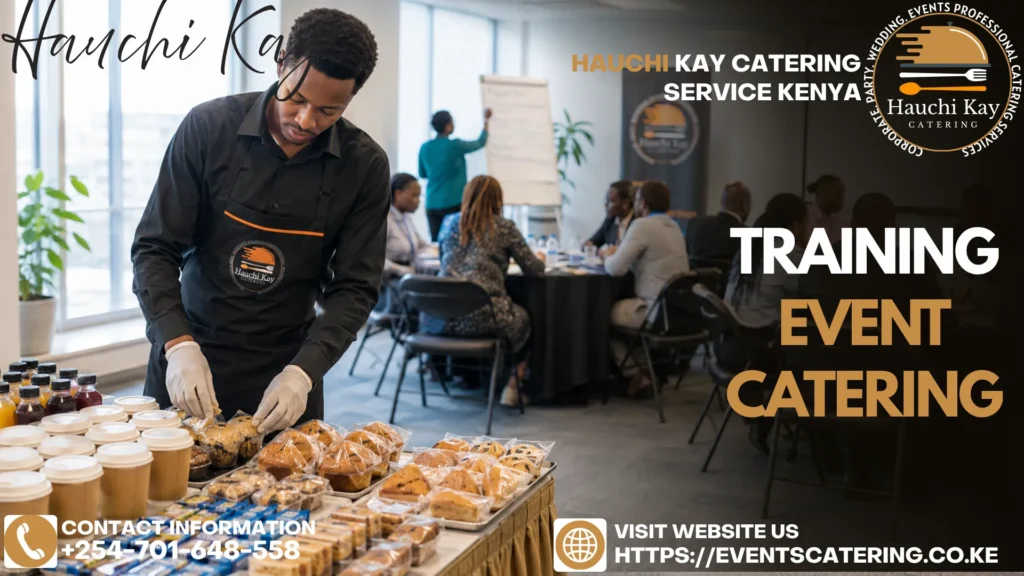
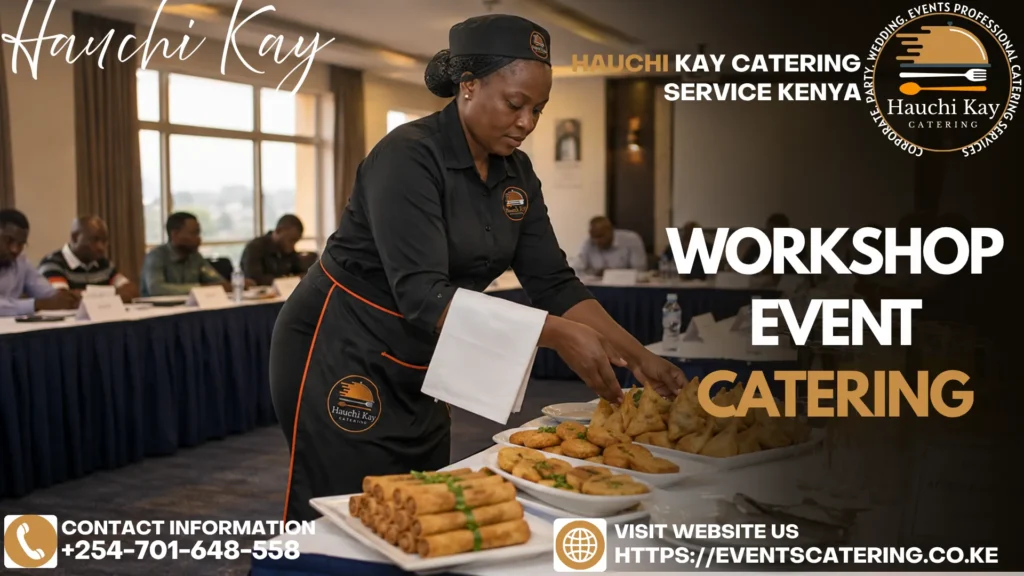
Hauchi Kay plans multi-day training menus as a rotation from the outset rather than picking one strong menu and reusing it. A typical five-day rotation might open with a pilau and grilled chicken lunch on day one, move to a coconut rice and fish curry on day two, a beef stew with mukimo on day three, a chapati and lentil combination with a vegetable stir fry on day four, and close on day five with a lighter plated lunch, grilled tilapia with a herb salad, that sends delegates home on a strong note rather than a heavy one. Morning and afternoon teas rotate too: mandazi and mahamri one day, samosas and spring rolls the next, muffins and fresh fruit skewers after that, so the same pastry plate never appears twice in a week.
Tracking Dietary Needs Across Multiple Days
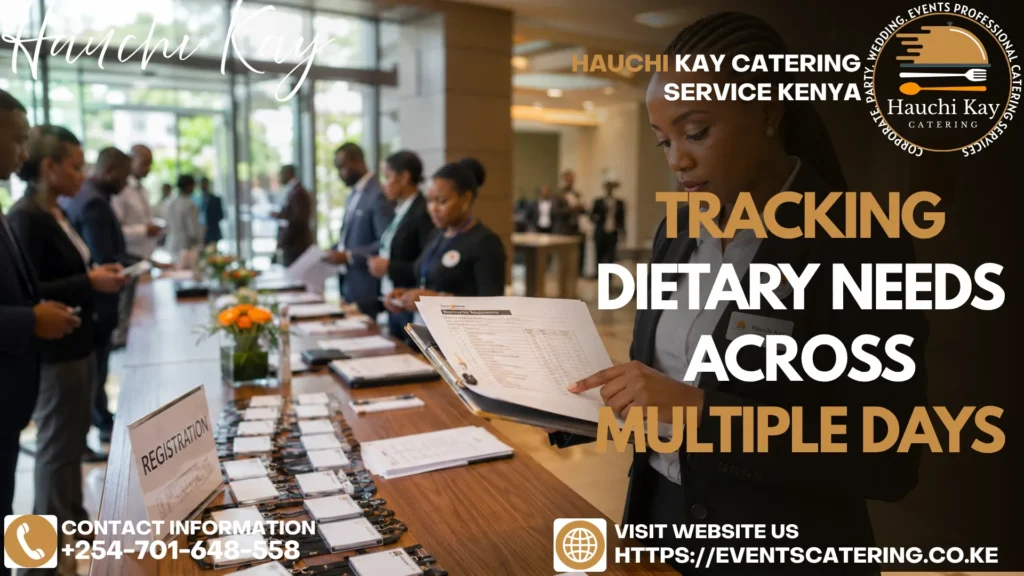
Dietary planning gets harder, not easier, over a multi-day run, because a delegate who ticked “vegetarian” on a form submitted three weeks earlier is easy to lose track of by day four unless someone is actively managing it. Hauchi Kay keeps a running dietary sheet per programme, cross-checked against the registration desk’s numbers each morning, precisely because a missed dietary requirement on day one is forgivable but the same miss on day three is not.
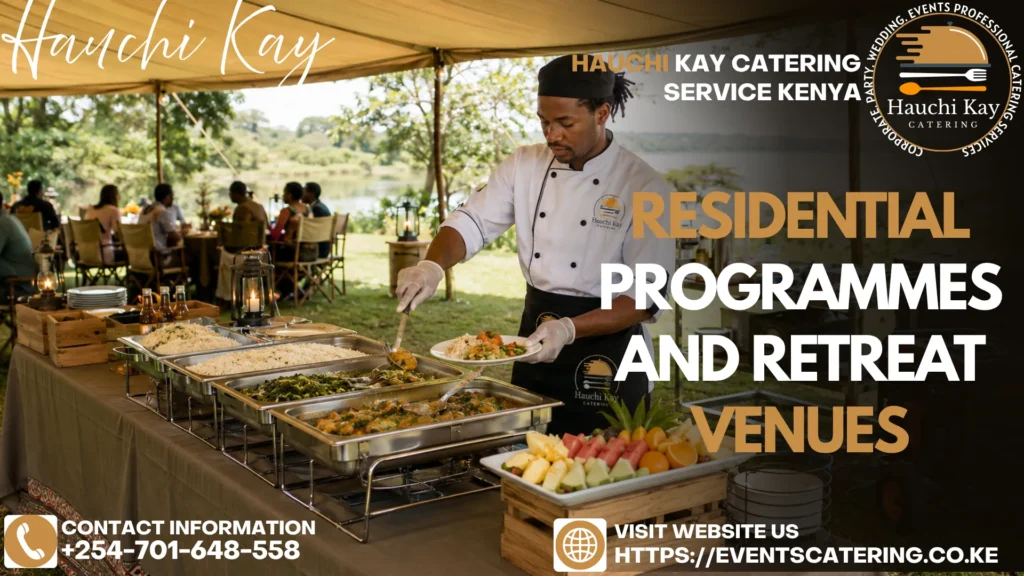
Residential Programmes and Retreat Venues
For residential trainings, where the same group also eats breakfast and sometimes dinner together, the rotation logic extends across all meals, not just lunch. This is typically where retreat-style venues outside Nairobi, Naivasha, Machakos, and similar spots come into play, and where a caterer with experience travelling equipment and staff outside the city becomes genuinely necessary rather than a nice-to-have.
Matching the Venue to the Catering
Where a conference, seminar or training happens shapes what catering can realistically deliver, and it’s worth thinking through before the menu conversation starts.
Hotel Conference Floors
Hotel conference floors, common across Nairobi’s Upper Hill, Westlands and Kilimani business districts, usually come with in-house catering kitchens, which simplifies logistics but sometimes limits menu flexibility if the venue insists on its own kitchen handling food safety. Hauchi Kay works within these arrangements regularly, either supplying full external catering where the hotel permits outside caterers, or coordinating closely with an in-house kitchen on menu design and timing.
Standalone Conference Centres
Standalone conference centres, the kind built specifically for large-scale events with a plenary hall and several breakout syndicate rooms, tend to give a caterer more control over station placement and queue flow, since the space is designed around exactly this kind of movement. These venues suit conferences and training programmes with more than 150 delegates particularly well.
Training Institutes and In-House Office Venues
Training institutes and university executive programme venues bring their own rhythm, often with fixed meal times built into an academic-style schedule and a captive audience who eat every meal on site for the length of a course. Corporate training rooms inside a company’s own offices are the fourth common format, and probably the trickiest logistically, since catering has to work around building security, lift capacity, and whatever kitchen or pantry space the office actually has, which is sometimes none at all.
None of these formats is better than another. They simply demand a different catering plan, and Hauchi Kay’s first question to any conference or training organiser is almost always about the venue before it’s about the menu.
Menus Built Around Concentration, Not Just Comfort
Food served to a room that has to go back to work in twenty minutes needs to do a different job to food served at a wedding. A heavy, carbohydrate-dense lunch that would be perfectly welcome at a celebration can leave a training room sluggish by two in the afternoon, and a facilitator fighting a room’s post-lunch energy dip is fighting a battle the caterer could have prevented.
Morning Tea and Working Lunch
Morning tea for a conference or training day typically runs light and energising: fresh coffee, Kenyan tea, mandazi or mahamri, seasonal fruit, sometimes a boiled egg option for delegates who skipped breakfast. Working lunches lean toward balanced plates rather than the heaviest option on the menu, pilau or steamed rice with grilled chicken or fish, a vegetable side like sukuma wiki or terere, a fresh kachumbari, and a lighter dessert such as a fruit platter rather than anything too rich. Afternoon tea, served with the final stretch of the day still ahead, usually stays savoury and quick to eat standing up: samosas, spring rolls, vegetable cutlets, alongside fresh juice and a second coffee round for anyone flagging.
Breakfast and Dinner for Residential Programmes
Multi-day and residential programmes sometimes extend to breakfast and dinner as well. Breakfast for delegates staying overnight tends toward a fuller spread, eggs, sausages, sweet potatoes or arrow roots, bread and preserves, since there’s more time before the first session. Evening dinners on residential programmes can shift toward a slightly more relaxed, plated format, giving delegates a proper sit-down meal after a full day of sessions, sometimes with a lighter dessert station if the programme includes an evening networking element.
Dietary Variety Across Every Rotation
Dietary variety sits underneath all of this. Vegetarian, vegan, halal and allergen-aware options are built into every rotation from the planning stage rather than added as an afterthought, because a training room with fifteen unaccommodated dietary requirements creates far more disruption than the catering budget saved by skipping the planning conversation.
Meal-by-Meal Menu Breakdown
The rotations described above draw from a wider pool of options Hauchi Kay works with across conference, seminar, workshop and training bookings. The breakdown below shows the range available at each meal point, so a full menu can be built around your specific programme length and delegate profile.
Breakfast (Residential and Early-Start Programmes)
| Course | Options |
| Hot dishes | Eggs, sausages, pancakes, sweet potatoes, arrow roots |
| Breads and spreads | Bread, butter and jam, mandazi, mahamri |
| Beverages | Kenyan tea, fresh coffee, fresh juice |
| Fruit | Seasonal fruit platter |
Morning Tea
| Course | Options |
| Beverages | Kenyan tea, fresh coffee, fresh juice |
| Savoury bites | Samosas, spring rolls |
| Sweet bites | Cookies, muffins |
| Fruit | Seasonal fruit |
Working Lunch Buffet
| Course | Options |
| Carbohydrates | Pilau, steamed rice, coconut rice, ugali, chapati, mukimo, mashed potatoes |
| Proteins | Beef stew, beef fry, chicken curry, grilled chicken, fried fish, tilapia, goat stew, beans, lentils, green grams |
| Vegetables | Sukuma wiki, spinach, mixed vegetables, cabbage, managu, terere |
| Salads | Kachumbari, coleslaw, green salad, pasta salad |
| Desserts | Fruit platter, cake, pudding, ice cream |
Afternoon Tea
| Course | Options |
| Beverages | Kenyan tea, fresh coffee, fresh juice |
| Savoury | Sandwiches, samosas, kebabs |
| Sweet | Cakes, doughnuts |
| Fruit | Seasonal fruit |
Evening Dinner (Residential Programmes)
| Course | Options |
| Starters | Soup, canapés |
| Mains | Grilled beef fillet, grilled fish, chicken breast, vegetarian option |
| Sides | Seasonal vegetables, starch of choice |
| Dessert | Plated dessert, fruit platter |
Every menu above rotates according to programme length, so a two-day seminar draws a smaller selection while a five-day residential training rotates through the fuller range without repeating a dish within the same week.
Who Books This Kind of Catering in Kenya
Conference, seminar, workshop and training catering serves a specific mix of clients, and it’s worth naming them because their needs differ slightly even within this one category.
Corporate Learning and Development
Corporate learning and development departments run the largest volume, booking recurring internal training programmes, onboarding weeks, and leadership development courses, often with the same headcount and venue used repeatedly across a year.
Professional Bodies and Membership Associations
Professional bodies and membership associations, the kind offering continuing professional development points to members in accounting, law, engineering and similar fields, book conference and seminar catering for CPD sessions that can run anywhere from a half-day workshop to a multi-day annual conference.
Government Agencies and Training Institutes
Government agencies and training institutes run structured, often multi-day residential courses, sometimes at retreat venues outside Nairobi, where catering needs to travel with the programme.
NGOs and Development Organisations
NGOs and development organisations run frequent workshops and stakeholder convenings, often with tighter last-minute headcount changes than corporate clients, which puts a premium on a caterer’s ability to flex numbers close to the date.
Universities and Executive Education
Universities and executive education programmes round out the group, typically with fixed academic-calendar timing and a need for consistent, dependable catering across an entire term or course intake.
A Short Checklist Before You Confirm Numbers
A few questions, answered honestly before a quote is requested, save most of the last-minute scrambling that derails conference and training catering.
- How many breakout rooms or syndicate sessions run at once, and do their break times overlap or stagger.
- Is this a single day, or does the menu need to rotate across multiple days without repeating.
- What is the realistic guaranteed minimum headcount, separate from the optimistic invitation list.
- Does the venue have its own kitchen, or does catering need to bring full equipment on site.
- Are there dietary requirements already known, and is there a process to catch new ones that surface closer to the date.
- Is the venue inside Nairobi, or does staff and equipment need to travel to a retreat or regional location.
Working through this list before requesting a quote usually shortens the whole planning conversation, because it answers most of the questions a caterer would otherwise need to ask first.
Packages and Indicative Pricing
Every conference, seminar, workshop and training programme carries its own brief, so Hauchi Kay builds a tailored quotation for each one rather than working from a fixed price list. The four planning tiers below give a sense of what different budgets typically deliver, with the actual menu for each tier drawn from the rotation principles described above rather than a generic pricing line.
Custom Quote
Contact us for a tailored quotation based on guest numbers, menu selection, venue, staffing requirements, equipment, logistics, dietary preferences, service style and event duration.
Premium Package
Morning tea of fresh coffee, Kenyan tea and mandazi with seasonal fruit. Working lunch of grilled tilapia or chicken, pilau, kachumbari and a vegetable side. Afternoon tea of samosas, spring rolls and fresh juice. Suited to single-day conferences and seminars.
| Package | Menu Included | Price per Delegate per Day (KES) |
| Premium Package | Morning tea, working lunch buffet, afternoon tea, one service station per 45 delegates | 3,800 – 4,600 |
Executive Package
Multi-day rotating menu across breakfast, morning tea, working lunch and afternoon tea, with a different lunch main and pastry selection scheduled for each day of the programme. Includes a live carving or grilling station for lunch and a dedicated dietary coordinator for the full programme.
| Package | Menu Included | Price per Delegate per Day (KES) |
| Executive Package | Full-day rotation, live lunch station, dedicated dietary tracking, multi-station tea breaks | 5,200 – 6,200 |
Luxury Package
Residential or high-profile conference format with a plated working lunch, a live cooking station, a branded tea break setup matching event colours, and an evening plated dinner with wine service for residential programmes.
| Package | Menu Included | Price per Delegate per Day (KES) |
| Luxury Package | Plated lunch, branded stations, evening dinner with wine service, dedicated event manager on site | 7,500 – 9,500 |
Pricing Disclaimer: The prices shown are premium market estimates intended for planning purposes only. Final quotations depend on guest numbers, menu complexity, venue, staffing, transport, equipment hire, service style, seasonal ingredient costs and any special client requirements. Contact us for a customised quotation tailored to your event.
For a full comparison across all eleven Hauchi Kay corporate catering categories, including boardroom lunches, AGM catering, staff appreciation events and product launches, the Corporate Catering in Kenya page is the place to see how this category sits alongside the others before requesting a quote.
Frequently Asked Questions
How do you stop tea break queues from running over the scheduled time?
Through station count matched to headcount, roughly one station per forty to fifty delegates for tea breaks, staggered service timed to when breakout rooms actually finish rather than a single fixed moment, and pre-portioned grab-and-go options for very tight ten-minute breaks.
Can the menu rotate across a five-day training without repeating dishes?
Yes. Hauchi Kay plans multi-day menus as a full rotation from the start, varying the lunch main, the tea break pastry, and the side dishes across each day of the programme so nothing repeats within a single week.
Do you cater training programmes outside Nairobi, such as retreat venues in Naivasha or Machakos?
Yes, Hauchi Kay travels staff and equipment to regional and retreat venues for multi-day residential training, with logistics planned around the venue’s kitchen access and delivery routes in advance.
What happens if our delegate numbers change close to the training date?
A guaranteed minimum headcount is confirmed a few days before the event, with reasonable flexibility built in for last-minute increases. Significant last-minute reductions are best flagged as early as possible to avoid unnecessary food preparation.
Can you manage a mixed group with halal, vegetarian and vegan delegates in the same training?
Yes, dietary requirements are built into every day’s rotation from the planning stage, with a running dietary sheet tracked against the registration desk each morning of a multi-day programme.
Does the per-delegate pricing include staff and serving equipment?
The pricing above covers food, standard service staff and the serving stations described in each package. Additional equipment such as branded signage, specialised bar service or extended AV-adjacent catering setups is quoted separately based on the event.